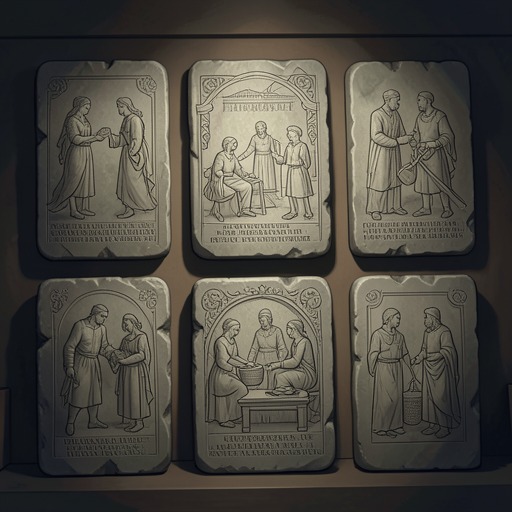
Law of the Twelve Tables
The Second SexThe Law of the Twelve Tables is presented as a pivotal point in the changing legal position of Roman women. In Simone de Beauvoir’s account, its significance lies not in establishing women’s autonomy, but in bringing the competing claims of paternal and marital families into view and helping produce a change in marriage law. That change redistributed male authority without removing women from guardianship.
Roman family and legal context
After the death of Tarquinius, patriarchy became established in Rome as agricultural property and the private estate made the family a central unit of society. Women were subordinated to the family patrimony, excluded from public affairs and from offices designated as masculine, and treated as perpetual minors in civil life. Although a woman was not directly deprived of her paternal inheritance, guardianship restricted her ability to use it independently.
Before the legal shift associated with the Twelve Tables, Roman marriage with manus could take three forms: confarreatio, in which the couple offered a spelt cake to Jupiter in a religious ceremony; coemptio, a fictitious sale in which the father transferred his daughter to her husband; and usus, based on a year of cohabitation. In each form, the husband replaced the woman’s father or male relatives as the authority over her. She was treated as one of her husband’s daughters, and he held power over both her person and her property.
The legal change and its limits
The Twelve Tables figure in the account as the point from which conflict between a woman’s paternal and conjugal families led to her legal emancipation. The resulting shift was not emancipation from male control. Rather, the emergence of marriage without manus defended paternal relatives’ interests: a woman’s property remained under her guardians’ control, while her husband’s authority extended to her person. Her father, as paterfamilias, could still retain absolute authority over her.
A family court could settle disputes between father and husband, giving a woman recourse from one authority to the other. This arrangement meant she was not simply one man’s possession, but it did not make her an independent legal subject. The law adjusted the balance between male relatives; it left the woman within a structure of guardianship.
Legal status and lived position
The Roman example illustrates Simone de Beauvoir’s distinction between abstract rights and women’s concrete circumstances. The father’s authority was extensive, yet he was also a citizen who administered the household and its members in relation to public life. A woman’s economic and domestic contribution could therefore give her a substantial place within the family even as the law constrained her independence.
Unlike the Greek woman, the Roman matron was not confined to a separate women’s quarter. She occupied the atrium, directed enslaved people’s work, oversaw children’s education, shared her husband’s concerns, and was regarded as a co-owner of his property. Her social presence and influence did not cancel her legal subordination. The contrast makes the Twelve Tables’ significance more complex: changes in legal arrangements mattered, but neither legal status alone nor a household woman’s practical influence fully described her actual position.